
- New FOI data suggests fragmented progress across five current AI Growth Zones (AIGZs)
- Planning progress in England’s first announced zone in Culham is slowing, with only one permission granted for commercial and infrastructure last year, compared to 8 in 2023
- Calls for real-time pipeline visibility and standardised digital-first AIGZ datasets to sit across multiple government departments, in order to add clarity to current bottlenecks
AI Growth Zones (AIGZs) have generated political momentum and fresh support has been promised under the National Planning Policy Framework. However, FOI data analysed by the national property data firm, Search Acumen, shows there is no development pipeline yet. For the commercial property market, questions remain on whether AIGZs can actually be delivered within this parliament, says the firm, given the significant planning and grid constraints they continue to face.
Where are the AI Growth Zones, and what is the intention?
The UK government first unveiled the concept of AI Growth Zones (AIGZs) in January 2025 as part of its AI Opportunities Action Plan. Chosen for their access to large energy capacity, available land often from former industrial sites, and potential to host hyperscale data centres. So far, five areas have been announced, including Culham in Oxfordshire (Jan 2025), Blyth & Cobalt Park in the North East (Sept 2025), Anglesey & Trawsfynydd in North Wales (Nov 2025), Bridgend in South Wales (Nov 2025), and Lanarkshire in Scotland (Jan 2026).
Rather than enterprise zones with tax breaks, these are areas that would receive special consideration for speeding up planning approval times, priority access to the energy grid, and placement at the front of the line for private partnerships with major tech firms.
Planning analysis – a fragmented picture
Search Acumen analysis of district planning for major industry and warehousing, as well as public service infrastructure, which includes the storage of data, reveals a mixed picture in England [Table 1].
Culham in Oxfordshire was the first area to be announced as an AIGZ in January 2025, but showed the least progress by the end of that year, with only one permission granted, sitting significantly below its 2023 peak, when 8 projects were approved.
In the year before its status was made public, there were some promising wins, however. These included a ground-mounted solar farm and battery energy storage system (BESS) at Pangbourne Technology Centre, FOI data reveals. But the recent slowdown in progress at Culham Campas has been largely attributed to power and grid constraints.
Culham was chosen partly because the shutdown of the JET fusion reactor freed up a rare high-capacity grid connection. But scaling beyond that is difficult. Across the UK, grid queues for new power connections are heavily congested, and even “fast-track” projects still face years of energy and transmission work. Another major criticism is that the project has political backing but unclear operational ownership. Different departments control AI policy, energy, planning permission, and infrastructure, which slows execution.
Furthermore, Culham’s location in a water-stressed part of southern England has raised concerns. Meeting the Government’s AI data centre targets may lead to higher water bills and greater water extraction from rivers to support the vast volume of hydropower required.
It is a similar picture across other zones.
Blyth & Cobalt Park in North Tyneside has been similarly inactive since its status was announced in September 2025, but approved the most commercial projects since 2022 in the immediate run-up to the announcement[1]. Planning granted just before AIGZ status included a Battery Energy Storage Facility (BESS) and associated infrastructure, according to FOI data.
Anglesey & Trawsfynydd in North Wales was announced as a AIGZ in November 2025. Whilst one AI Data Centre has been rejected at the Anglesey chemical factory since this time, another two related projects have been expanded at Carrog BESS and an electricity substation at Wylfa – the site for new SMR technology in partnership with Rolls-Royce SMR.
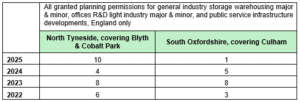
Table 1. Source: Search Acumen analysis of District Planning Application Statistics, England only
What does this tell us? Investor caution or policy failure
These fragmented wins, often occurring before zone announcements, don’t feel aligned with national momentum, says Search Acumen. No evidence designation has simplified or accelerated planning consent yet. Whilst the zones are backed by potentially billions in private investment, early-stage evidence and the government’s own metrics on real-world impact remain quite thin.
Andrew Lloyd, Managing Director of Search Acumen, explains, “For occupiers or developers banking on AI Growth Zone status to de-risk a site or speed up a consent, this data offers no reassurance.
“That’s a significant signal for anyone pricing risk on an AI-adjacent development. There are brownfield opportunities, but these remain untested.
“The simple fact that there are so few of these AI-related initiatives coming forward within designated zones, with many classified as minor, and often still undetermined in planning status, tells you just how early-stage the market actually is versus the political narrative around it.
“There is also limited auditing of investment claims, but the real test will be if sites are still empty land parcels by the end of the current government’s tenure – something which it be trying to avoid to prove its concept.
Search Acumen points to the success of Slough, regarded as Europe’s largest collection of data centres and the world’s second-largest data hub behind Virginia, USA. Its location is important, with an inbuilt high-capacity power infrastructure from its 100-year history as an industrial area and access to low-latency connectivity to London.
Many locations identified as AI Growth Zones by the government have far fewer industrial roots and limited access to hydropower, raising questions about their viability.
Andrew adds, “Some rural locations would have been chosen deliberately further away from London to close the North-South gap, but without existing infrastructure and on relatively unknown test ground, you tend to get a blockade in local planning that is counter to national initiatives.”
But the pipeline gap could reflect rational caution, signalling that investors may be waiting for the right market cues.
Andrew says, “Developers may not commit to planning fees until grid connections are confirmed, policy is clearer, and occupier demand is more certain. For commercial real estate professionals, the question is whether this is a temporary lag or a structural signal that the zones lack the delivery infrastructure to attract capital.
“With almost nothing coming through the system, there’s no evidence yet of the capacity or policy framework to handle major AI infrastructure applications when they do arrive. That’s a risk for any developer who moves early, as they may be finding their way in a policy vacuum.”
What’s next?
Described by the government as “dedicated hotbeds for AI infrastructure development”, Andrew says this ‘hotbed’ status will surely be contested if activity doesn’t improve.
“Whilst policy can provide the rhetoric, it will be private investors that provide the cash to get spades in the ground.
“If you have a situation where economic headwinds spook markets, delays in progress feel inevitable. But bottlenecks across planning and related property and legal workflows remain in our control and should be eased as a priority. This starts with real-time pipeline visibility: FOIs are a workaround for fragmented, inconsistently structured planning data. Standardised, digital-first datasets and dashboards would help track whether zones are evidentially accelerating delivery.
“Ultimately, practical realities of power, planning, cooling, construction capacity, and government coordination are without doubt slowing delivery. Culham has effectively become a test case for this, telling us whether the UK can build AI infrastructure at hyperscale fast enough to compete internationally. So far, the answer is undecided.
Andrew concludes, “The challenge with AI is that you can’t stop it. AI Growth Zones will become a problem for the next government.”
[1] 2022 chosen as a cut off point to avoid unnaturally inflated and deflated data during the pandemic